
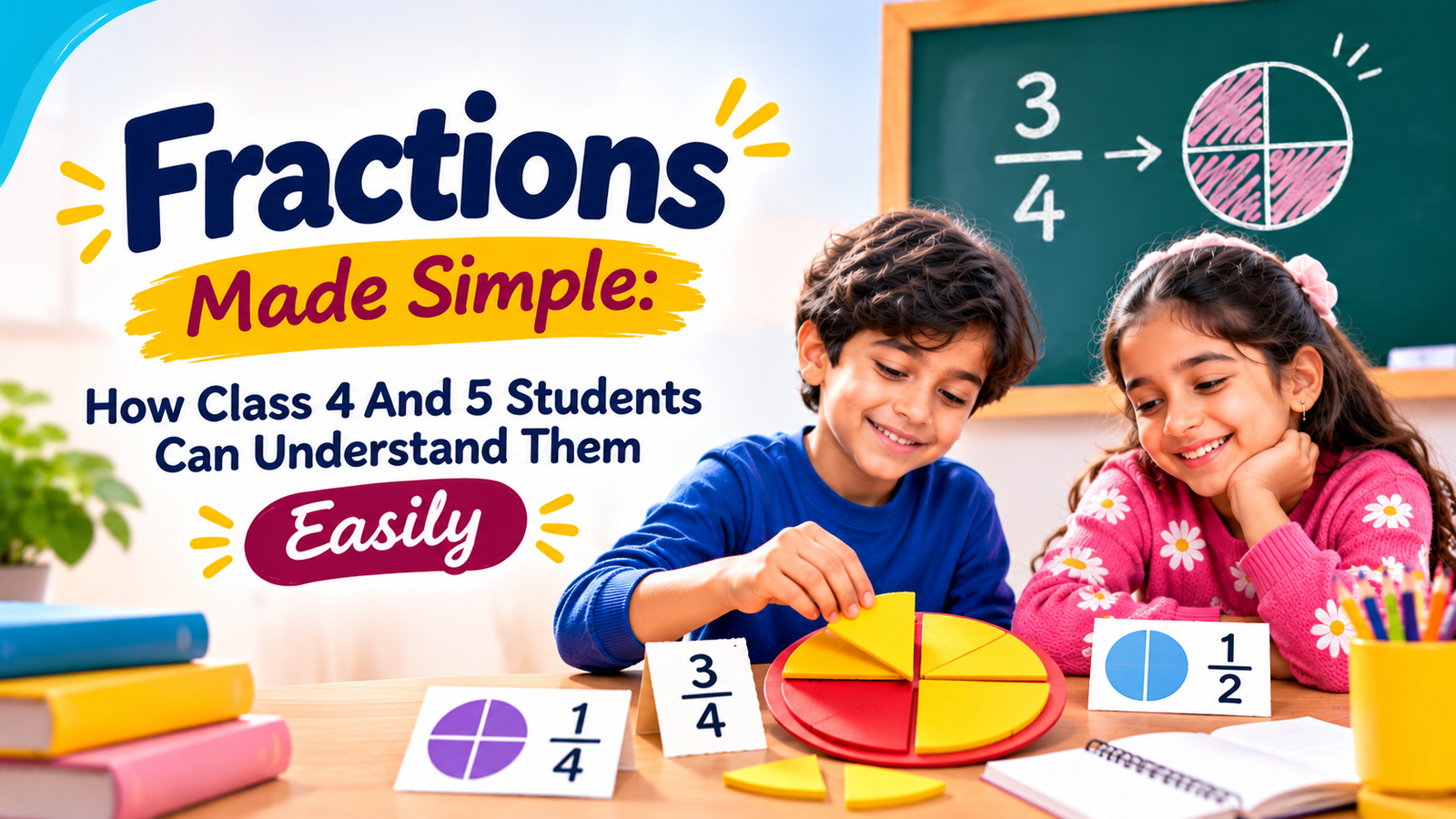
Fractions are an important maths topic.
They help us understand parts of things.
Students use fractions in everyday situations.
Sharing food is one simple example.
Measuring ingredients is another common example.
Many students find fractions confusing initially.
The good news is simple.
Fractions become easier with practice.
Visual examples also make learning enjoyable.
In this guide, we will explore fractions.
We will learn their basic parts.
We will understand equivalent fractions.
We will also solve practice questions.
What Is A Fraction?
A fraction represents part of a whole.
It shows equal parts of something.
Imagine a pizza cut into four slices.
You eat one slice.
You have eaten one-fourth of the pizza.
We write this fraction as 1/4.
Here, the whole pizza has four equal parts.
You have taken one part.
Fractions help us describe these parts.
Understanding The Numerator And Denominator
Every fraction has two important numbers.
These numbers are the numerator and denominator.
Consider this fraction: 3/4
- Numerator: The top number is 3.
- Denominator: The bottom number is 4.
The numerator shows the parts selected.
The denominator shows all equal parts.
Let’s understand this with an example.
A chocolate bar has eight equal pieces.
You eat three pieces.
You have eaten 3/8 of it.
Here, 3 is the numerator.
And 8 is the denominator.
Remember this simple rule.
The denominator cannot be zero.
Fractions Through Visual Examples
Pictures make fractions easier to understand.
They help students see equal parts.
Example 1: Understanding One-Half
Imagine a circle divided into two equal parts.
One part is shaded.
The shaded fraction is 1/2.
One part is shaded.
Two equal parts make the whole.
Therefore, the shaded portion is one-half.
Example 2: Understanding Three-Fourths
Imagine a rectangle divided into four equal parts.
Three parts are shaded.
The shaded fraction is 3/4.
Three parts are shaded.
Four equal parts make the whole.
Therefore, the shaded portion is three-fourths.
Example 3: Understanding Two-Thirds
Imagine six equal apple slices.
You eat four slices.
The fraction eaten is 4/6.
This fraction also equals 2/3.
Both fractions represent the same amount.
We will understand this shortly.
Types Of Fractions Students Should Know
Students encounter different fractions in maths.
Let’s understand the common types.
1. Proper Fractions
A proper fraction has a smaller numerator.
Its numerator is smaller than its denominator.
Examples include:
- 1/2
- 2/5
- 3/8
These fractions represent less than one whole.
2. Improper Fractions
An improper fraction has a larger numerator.
Its numerator equals or exceeds its denominator.
Examples include:
- 5/4
- 7/3
- 8/8
An improper fraction can represent one whole.
It can also represent more than one whole.
3. Mixed Numbers
A mixed number combines two parts.
It includes a whole number and fraction.
Examples include:
- 1 1/2
- 2 1/4
- 3 2/5
For example, 1 1/2 means one-and-a-half.
It represents one whole and one-half.
What Are Equivalent Fractions?
Equivalent fractions represent the same value.
Their numbers may look different.
Consider these fractions:
1/2 = 2/4 = 3/6
Each fraction represents one-half.
Imagine a chocolate bar.
First, divide it into two equal parts.
Shade one part.
Now, divide another identical bar.
Make four equal parts.
Shade two parts.
Both shaded portions are equal.
That is how equivalent fractions work.
How To Find Equivalent Fractions
Multiply both numbers by the same number.
The fraction’s value remains unchanged.
Example:
1/3 × 2/2 = 2/6
Similarly:
1/3 × 3/3 = 3/9
Therefore:
1/3 = 2/6 = 3/9
You can also simplify fractions.
Divide both numbers by their common factor.
Example:
4/8 = 1/2
Both numbers divide by four.
This gives the simplest form.
How To Compare Fractions
Comparing fractions helps us identify sizes.
We can find the larger fraction.
When Denominators Are The Same
Compare the numerators.
Example:
3/7 and 5/7
Both fractions have equal denominators.
Compare their numerators.
Since 5 is greater than 3:
5/7 > 3/7
When Numerators Are The Same
Compare the denominators.
Example:
1/3 and 1/5
Both fractions have numerator one.
Thirds are larger than fifths.
Therefore:
1/3 > 1/5
Imagine two identical pizzas.
Cut one into three equal slices.
Cut another into five equal slices.
A third is larger than a fifth.
When Both Numbers Are Different
Find equivalent fractions first.
Example:
1/2 and 2/3
Convert them into sixths.
1/2 = 3/6
2/3 = 4/6
Now compare their numerators.
Therefore:
2/3 > 1/2
How To Add Fractions
Adding fractions depends on denominators.
Adding Fractions With Equal Denominators
Add the numerators.
Keep the denominator unchanged.
Example:
2/7 + 3/7 = 5/7
We add 2 and 3.
The denominator remains seven.
Adding Fractions With Different Denominators
First, find a common denominator.
Then convert the fractions.
Example:
1/2 + 1/4
Convert one-half into fourths.
1/2 = 2/4
Now add the fractions.
2/4 + 1/4 = 3/4
The answer is three-fourths.
How To Subtract Fractions
Subtraction follows a similar method.
Subtracting Fractions With Equal Denominators
Subtract the numerators.
Keep the denominator unchanged.
Example:
5/8 − 2/8 = 3/8
Subtracting Fractions With Different Denominators
Find a common denominator first.
Example:
3/4 − 1/2
Convert one-half into fourths.
1/2 = 2/4
Now subtract.
3/4 − 2/4 = 1/4
The answer is one-fourth.
Common Fraction Mistakes To Avoid
Students sometimes make simple mistakes.
Understanding these mistakes improves accuracy.
Mistake 1: Adding Both Denominators
Incorrect:
1/4 + 2/4 = 3/8
Correct:
1/4 + 2/4 = 3/4
Add numerators only.
Keep equal denominators unchanged.
Mistake 2: Ignoring Equal Parts
Fractions represent equal parts of a whole.
Unequal parts cannot be counted directly.
Mistake 3: Forgetting Simplification
Some fractions have simpler forms.
For example:
6/8 = 3/4
Always check for common factors.
Mistake 4: Confusing Numerators And Denominators
The numerator shows selected parts.
The denominator shows total equal parts.
Remember their positions.
Simple Ways To Practise Fractions
Fractions become easier with daily activities.
Try these enjoyable learning methods.
- Divide sandwiches into equal pieces.
- Share fruits equally among family members.
- Draw circles and shade different portions.
- Fold paper into equal sections.
- Measure ingredients during cooking.
These activities build practical understanding.
Parents can encourage regular practice.
Short sessions often feel more manageable.
Fraction Practice Questions For Class 4 And 5
Now, test your understanding.
Try solving these questions independently.
Section A: Basic Fractions
- Write the fraction for two shaded parts.
There are five equal parts altogether. - In 4/9, identify the numerator.
- In 3/8, identify the denominator.
- Write one equivalent fraction for 1/2.
- Simplify 4/8.
Section B: Compare And Calculate
- Which fraction is greater: 2/7 or 5/7?
- Which fraction is greater: 1/4 or 1/2?
- Solve: 2/9 + 4/9.
- Solve: 7/10 − 3/10.
- Solve: 1/2 + 1/4.
Section C: Word Problems
- Riya eats two slices of pizza.
The pizza has eight equal slices.
What fraction did she eat? - A ribbon measures 3/4 metre.
Another ribbon measures 1/4 metre.
What is their total length? - Aarav reads 2/5 of his book.
He later reads another 1/5.
What fraction has he read altogether?
Answers To Fraction Practice Questions
Check your answers below.
- 2/5
- 4
- 8
- 2/4 or another equivalent fraction
- 1/2
- 5/7
- 1/2
- 6/9 or 2/3
- 4/10 or 2/5
- 3/4
- 2/8 or 1/4
- 4/4 metre or 1 metre
- 3/5
Review any incorrect answers.
Understand the method before trying again.
How Mathematics Tuition Helps Students
Fractions require practice and clear explanations.
Some students need additional learning support.
Good teaching builds strong mathematical foundations.
It also improves confidence and accuracy.
At Charu Tuition Academy, students strengthen maths skills.
They learn concepts through guided practice.
Visual examples make difficult topics approachable.
Our learning approach supports primary students.
It encourages questions and independent thinking.
Looking for mathematics tuition for primary students?
Choose learning support that builds understanding.
Final Thoughts
Fractions become simple with regular practice.
Start with pictures and familiar objects.
Learn numerator and denominator carefully.
Practise equivalent fractions step by step.
Then, move towards calculations and word problems.
Small learning steps create lasting confidence.
Charu Tuition Academy helps students build foundations.
Learn maths with clarity and confidence.