
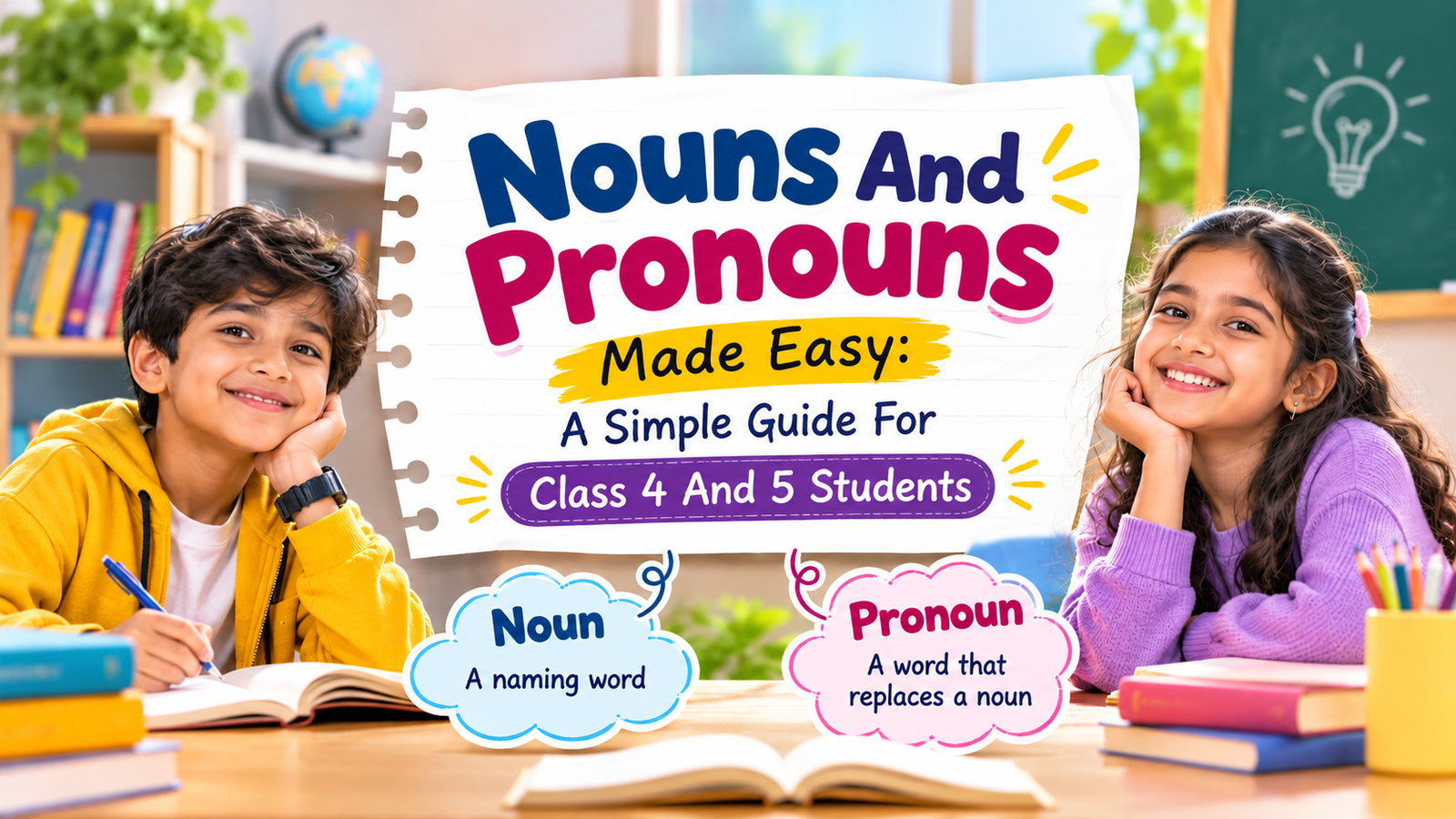
English grammar becomes easier with practice. Students first need to understand its basic concepts. Nouns and pronouns are important grammar topics. They help students build strong English foundations.
Many students learn grammar rules by memorising definitions. However, understanding these concepts is more useful. It helps students write better sentences. It also improves their speaking and reading skills.
In this guide, we will explore nouns and pronouns. We will understand their types and everyday uses. We will also learn common mistakes. Finally, students can practise with simple exercises.
At Charu Tuition Academy, we make English grammar simple. We help students understand concepts step by step. Our approach supports confident and effective learning.
What Is A Noun?
A noun is the name of a person, place, animal, or thing. It can also name a feeling, quality, or idea.
We use nouns in everyday conversations. We also use them in stories and schoolwork.
For example, consider a simple sentence:
Riya reads a book.
Here, Riya is a person’s name. Book names a thing. Both words are nouns.
Understanding nouns helps students identify sentence subjects. It also makes sentence formation easier.
Types Of Nouns For Class 4 And 5
Nouns have different types. Each type describes a particular kind of name.
1. Proper Nouns
A proper noun names a particular person, place, or organisation. It always begins with a capital letter in English.
For example, Rohan, Bengaluru, India, and Monday are proper nouns.
Proper nouns identify specific names. They help readers understand exactly who or what we mean.
Students should remember one important rule. Proper nouns begin with capital letters.
2. Common Nouns
A common noun names a general person, place, animal, or thing.
Examples include boy, city, school, dog, and teacher.
Unlike proper nouns, common nouns do not name specific individuals. They describe general categories.
For example, city is a common noun. Bengaluru is a proper noun.
This difference helps students recognise noun types correctly.
3. Collective Nouns
A collective noun names a group. It treats people, animals, or things as a unit.
Examples include team, class, family, and flock.
For example:
Our team won the match.
Here, team refers to a group. Collective nouns make sentences shorter and clearer.
4. Abstract Nouns
An abstract noun names a feeling, quality, state, or idea. We cannot usually experience these things through touch.
Examples include honesty, kindness, happiness, and courage.
Consider this sentence:
Honesty is an important quality.
Honesty is an abstract noun. It describes a quality rather than a physical object.
Learning abstract nouns improves vocabulary. It also helps students express feelings and ideas.
5. Material Nouns
A material noun names a substance or material. These materials can be used to make things.
Examples include gold, silver, wood, and cotton.
For example:
This table is made of wood.
Wood is the material noun here.
This category helps students describe objects. It also builds their understanding of descriptive writing.
What Is A Pronoun?
A pronoun is a word used instead of a noun. It helps avoid unnecessary repetition.
Consider this sentence:
Riya is my friend. Riya is very helpful.
Repeating Riya sounds awkward. We can improve the sentence.
Riya is my friend. She is very helpful.
Here, she replaces Riya. It is a pronoun.
Pronouns make sentences smoother. They also help students write more naturally.
Types Of Pronouns For Class 4 And 5
1. Personal Pronouns
Personal pronouns refer to people or things.
Common examples include I, you, he, she, it, we, and they.
These pronouns can also change according to their role.
For example:
She helped me.
She is the subject pronoun. Me is the object pronoun.
Students should learn these forms carefully. They help prevent common grammar mistakes.
2. Possessive Pronouns
Possessive pronouns show ownership. They tell us who owns something.
Examples include mine, yours, his, hers, ours, and theirs.
For example:
This pencil is mine.
Mine shows ownership.
Students should distinguish possessive pronouns from possessive determiners.
Compare these sentences:
This is my pencil.
This pencil is mine.
My comes before a noun. Mine stands independently.
3. Demonstrative Pronouns
Demonstrative pronouns point towards people or things.
The main words are this, that, these, and those.
We use them according to number and distance.
For example:
These are my books.
These points towards particular books.
Students should remember the basic pattern. This and that refer to singular things. These and those refer to plural things.
4. Interrogative Pronouns
Interrogative pronouns help ask questions.
Common examples include who, whom, whose, what, and which.
For example:
Who is standing outside?
Who asks about a person.
These pronouns help students frame questions. They are useful during conversations and writing activities.
5. Reflexive Pronouns
Reflexive pronouns refer back to the subject.
Examples include myself, yourself, himself, herself, and ourselves.
For example:
She completed the project herself.
Herself refers back to she.
These pronouns can add emphasis. They can also show that someone performs an action personally.
Difference Between Nouns And Pronouns
Nouns name people, places, things, or ideas. Pronouns replace nouns or refer to them.
Consider this example:
Aman lost his pencil. He found it later.
Aman and pencil are nouns. His, he, and it are pronouns.
Both are important for sentence formation. Nouns introduce people and things. Pronouns help avoid unnecessary repetition.
Understanding this difference improves writing. It also helps students identify sentence parts.
Common Mistakes Students Should Avoid
1. Using Incorrect Pronouns
Students sometimes confuse he, she, and they. Pronouns should match the person or thing being discussed.
For example:
Incorrect: Riya is kind. He helps everyone.
Correct: Riya is kind. She helps everyone.
Choosing suitable pronouns makes sentences clear.
2. Forgetting Capital Letters
Proper nouns require capital letters.
Incorrect: We visited delhi.
Correct: We visited Delhi.
Students should check names carefully. This small habit improves written presentation.
3. Confusing My And Mine
My and mine both show ownership. However, they work differently.
Incorrect: This book is my.
Correct: This book is mine.
Remember, my usually comes before a noun. Mine can stand alone.
4. Repeating Nouns Unnecessarily
Repeated nouns can make writing sound awkward.
Incorrect: Rahul has a bag. Rahul carries Rahul’s bag.
Better: Rahul has a bag. He carries it.
Pronouns make sentences more natural.
5. Using Unclear Pronouns
A pronoun should clearly refer to someone or something.
Consider this sentence:
Aman spoke to Raj when he arrived.
Who arrived? Aman or Raj?
The sentence is unclear. Rewriting it can prevent confusion.
Clear writing always identifies the intended person.
Practice Exercises For Class 4 And 5
Exercise 1: Identify The Nouns
Find the nouns in these sentences.
- The teacher explained the lesson.
- My family visited Bengaluru.
- Honesty builds trust.
Exercise 2: Replace Nouns With Pronouns
Rewrite these sentences using suitable pronouns.
- Meera is singing. Meera is happy.
- The dog is hungry. The dog wants food.
- Rahul and Aman are friends. Rahul and Aman study together.
Exercise 3: Choose The Correct Pronoun
- Riya is my sister. ___ is helpful.
- This bag belongs to me. It is ___.
- ___ is knocking at the door?
Options: She, mine, Who
Exercise 4: Identify The Noun Type
Identify the bold noun.
- Delhi is a busy city.
- The team practised together.
- Kindness makes relationships stronger.
Answers
Exercise 1:
- Teacher, lesson
- Family, Bengaluru
- Honesty, trust
Exercise 2:
- Meera is singing. She is happy.
- The dog is hungry. It wants food.
- Rahul and Aman are friends. They study together.
Exercise 3:
- She
- Mine
- Who
Exercise 4:
- Proper noun
- Collective noun
- Abstract noun
Easy Ways To Learn English Grammar
Read English Every Day
Reading introduces students to grammar naturally. They can read stories, short passages, and books.
Encourage them to notice nouns and pronouns. This builds grammar awareness gradually.
Practise With Everyday Objects
Students can identify nouns around them. They can name classroom objects and people.
Then they can create sentences using pronouns. This makes learning practical and enjoyable.
Maintain A Grammar Notebook
Write down new grammar rules. Add examples and important corrections.
Revise these notes regularly. This improves understanding and memory.
Write Short Paragraphs
Students can write about their family or school. Ask them to underline nouns.
Then ask them to circle pronouns. This activity improves sentence awareness.
How Charu Tuition Academy Helps Primary Students
Simple Grammar Explanations
We explain grammar using age-appropriate language. Students learn concepts without unnecessary confusion.
Practical Learning Activities
We encourage students to participate actively. Worksheets and exercises strengthen their understanding.
Personal Learning Support
Every child learns differently. Individual guidance helps address learning difficulties.
Strong English Foundation
We focus on grammar, vocabulary, reading, and writing. These skills support future academic learning.
Our approach makes English more approachable. It also encourages independent learning.
Final Thoughts
Nouns and pronouns form basic English grammar. Understanding them makes sentence formation easier.
Nouns help us name things. Pronouns help us avoid repetition.
Students should understand their uses. They should also practise writing regularly.
Small daily efforts improve grammar skills. They also build communication confidence.
At Charu Tuition Academy, we help students strengthen their English foundation through simple explanations and regular practice.
Looking for English tuition for primary students? We help children develop grammar skills and confident communication.
Learn grammar. Practise regularly. Express yourself confidently.
Charu Tuition Academy
Building knowledge, language skills, and confidence.